Trade deal signed between any two countries or regions will be of three types – FTA (Free Trade Agreement), PTA (Preferential Trade Agreement) and BTA (Bilateral Trade Agreement).
In FTA, 90%+ of traded goods/services will be duty free. FTA may be CEPA (Comprehensive Economic Partnership Agreement) or may be CECA (Comprehensive Economic Cooperation Agreement) or may be CETA (Comprehensive Economic And Trade Agreement) or may be ECTA (Economic Cooperation And Trade Agreement) or may be CECPA (Comprehensive Economic Cooperation And Partnership Agreement) depending on the different clauses defined in the agreement on goods, services, investment, technology sharing, professional mobility, mutual recognition of educational qualifications / business standards, establishing manufacturing facilities in each other’s country, paperless digital trade etc…
In PTA, tariffs are not brought down to zero as in FTA, but tariffs are reduced on selected products/services based on preference. In BTA, tariffs truly depends on the participating countries considering the product/service to be traded and also keeping in mind their own domestic market interest.
As on January 2026, India has signed 20+ FTA/PTA/BTA agreements with different countries or with different group of countries. In this post, we will see comprehensive list of all FTAs/PTAs/BTAs India has signed till now.
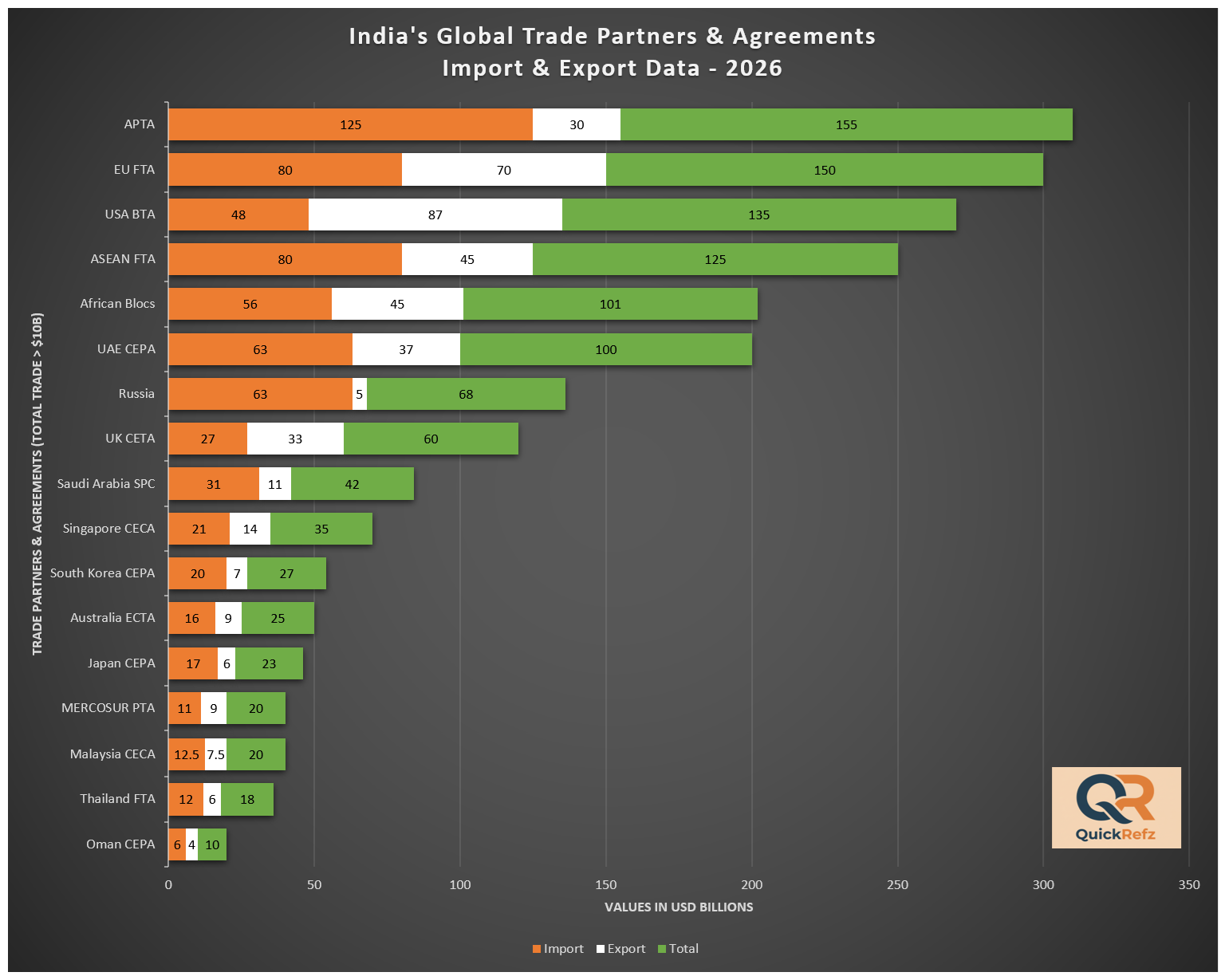
Below is the quick reference sheet for India’s global trade partners and agreements.

India’s Global Trade Partners And Agreements (FTA / PTA / BTA) – 2026
FTA : Free Trade Agreements
1) India-Sri Lanka FTA (ISFTA)
India-Sri Lanka Free Trade Agreement (ISFTA) is a bilateral trade agreement signed in 1998 and operational since 2000. It is one of the oldest agreement India has. This agreement includes only goods. Services and investments are not part of this agreement. It makes 4000+ product lines tariff free. Talks are in process to upgrade this agreement to make it more comprehensive involving goods, services, investment and technology cooperation. India is still Sri Lanka’s largest trading partner globally. Total traded value about to reach $6 Billion in FY 2025-26.
India Imports ($1.1B) : Tea, Spices(Black Pepper, Cinnamon), Rubber, Textile(Finished Products), Ships & Boats(Repair Services)
India Exports ($4.4B) : Petroleum products, Vehicles & it’s spare parts, Agriculture Products, Pharmaceuticals, Textile(Raw materials), Chemicals, Industrial Machineries
2) India-Nepal Treaties
India has a special trade relationship with Nepal defined by Open border trade. As Nepal is land locked and depends on India for its daily needs, almost all goods are duty free. India accounts for 70% of Nepal’s total import. The trade relationship with Nepal is managed by two treaties – Treaty of Trade and Treaty Of Transit. Treaty of trade provides Nepal duty free access to Indian market and through treaty of transit, Nepal can use Indian territory (Road, Rail and Ports) to trade with other countries like China, USA. Treaty of Transit is strategically very important for Nepal as it is landlocked on all sides.
India Imports ($1.5B) : Hydro Power, Edible oils, Ayurvedic medicinal herbs, Large Cardamom
India Exports ($7.5B) : Petroleum products (Petrol, diesel, LPG…), Agri products (rice, wheat, vegetables…), Pharmaceuticals, Automobiles and spare parts, Industrial Machineries, Construction Equipments.
3) India-Bhutan FTA
India-Bhutan FTA is a bilateral FTA which covers duty free trade of goods, transit of goods, open border trade and movement of people across the border. All import/exports are duty free and quota free. It is one of the most liberal trade agreement India has with any country. Bhutan imports 80% of its daily essential goods from India. India has invested in hydro-power projects in Bhutan which forms the major source of income for Bhutan. Bhutan earns by selling surplus electricity back to India which forms 40% of Bhutan’s revenue. As Bhutan is landlocked, according to transit of goods agreement, Bhutan can use Indian territory (Road, Railway, ports etc…) to trade with third countries like USA, Europe.
India Imports ($0.7B) : Hydropower, Ferro-Alloys, Agri products like cardamom, oranges, betel nuts.
India Exports ($1.3B) : Petroleum products, Food products, Pharmaceuticals, Construction materials, Industrial machineries, Consumer goods
4) India-Singapore CECA
India-Singapore CECA (Comprehensive Economic Cooperation Agreement) is India’s first comprehensive FTA active since 2005. This FTA is used by India as base model for later FTAs like UK, Japan etc. It covers almost all aspects of FTA like goods, services, investments and movement of professionals thus developing wholesome business ecosystem. Almost all of traded goods are 100% tariff free. But, CECA’s real power is not trade of goods, but real power lies in services and investment which is a major boost for Indian IT/ITES companies.
Singapore acts as Asia-Pacific HQ for most of Indian tech firms and many global companies use Singapore as regional HQ to invest in India as CECA provides legal protection. According to this agreement, professional qualifications/standards are mutually recognized thus easing the movement of professionals between two countries. Singapore is largest FDI investor of India invested heavily in Startups, funds and holding companies. Singapore is a major transit point for gold and silver entering India. Total valuation of trade between India and Singapore stood at $35 Billion in 2025-26.
India Imports ($21B) : Electronics components, High precision industrial machineries, Bullion, Plastics & Polymers
India Exports ($14B) : Petroleum Products, IT/ITES, Pharmaceuticals, Engineering Goods, Chemicals, Gems & Jewelry, Agri products, Electronics(Finished Products)
5) India-Thailand FTA (Early Harvest Scheme)
India-Thailand FTA is signed in 2003 and made operational from 2004. It is not a full comprehensive FTA. It is a partial FTA – first step towards full FTA. That’s why it is called early harvest scheme. In the early harvest scheme, countries reduce/eliminate tariffs on small list of products first. Full comprehensive FTA framework is signed later depending upon the results of early trade. Current India-Thailand FTA is limited to ~82 goods only. It doesn’t cover services and investment segment. As Thailand is a member of ASEAN, nowadays this agreement is rarely used as it is overshadowed by India-ASEAN FTA which covers more goods and covers services and investment segment also.
India Imports ($12B) : Palm oil, Air conditioners, Computer Hardware, Rubber
India Exports ($6B) : Industrial Machineries, Gems & Jewelry, Pharma & Chemicals, Iron & Steel Products, Marine products
6) India-ASEAN FTA (AIFTA : ASEAN-India Free Trade Area)
India-ASEAN FTA is a free trade agreement between India and all 10 ASEAN countries – Myanmar, Malaysia, Indonesia, Thailand, Vietnam, Philippines, Singapore, Laos, Brunei and Cambodia. It is a regional FTA operational since 2010 involving all south-east asian countries. It is a full comprehensive FTA covering goods (2010), services (2015) and investment (2015). This FTA makes 80% of products duty free and remaining products at 0-5% duty. This FTA is strategically important to India as it accounts to ~$125 Billions of trade every year. In ASEAN countries, Singapore is top partner followed by Indonesia & Malaysia.
India Imports ($80B) : Palm oil, Electronics & Computer hardwares, Industrial machineries, Electrical goods, Coal & Minerals, Plastic & Polymer products
India Exports ($45B) : Engineering goods (Auto components, Industrial machineries, Electrical equipments contribute 31% of export), Petroleum products, Pharma & Chemicals, Agri & marine products, Textiles
7) SAFTA – South Asian Free Trade Area
SAFTA is a free trade agreement comprising all 8 SAARC nations – India, Nepal, Bhutan, Sri Lanka, Maldives, Afghanistan, Bangladesh, Pakistan. It is signed in 2004 and operational since 2006. SAFTA is started with aim of promoting regional integration, cooperation and develop a free trade environment among SAARC nations, but it is overshadowed by conflict between neighboring countries especially India-Pakistan. India has halted trading with Pakistan completely after 2025 Pahalgam terror attack and India-Bangladesh relationship is at it’s lowest level with growing anti-India sentiment in Bangladesh.
SAFTA is goods-only free trade agreement to help people living in border areas. It doesn’t include services and investment segment. India uses SAFTA while trading with Bangladesh and little bit with Afghanistan. While trading with Nepal, Sri Lanka and Bhutan, bilateral FTAs are used instead of SAFTA. Trading with Pakistan is completely suspended. Relationship with Maldives is mainly focused on tourism. So, SAFTA is active only on paper while practically it is rarely used.
India Imports : Readymade garments, Hydro-power (From Bhutan & Nepal), Agricultural products (limited like dry fruits from Afghanistan)
India Exports : Cotton Yarn, Pharmaceuticals, FMCG products, Construction Materials, Agri Products (Sugar, rice, wheat)
8) India-Japan CEPA
India-Japan CEPA (Comprehensive Economic Partnership Agreement) is a bilateral FTA active since 2011. CEPA is next level FTA where agreement is not just about trade but it is a strategic partnership covering many aspects of bilateral relationship like technology sharing, infrastructure development, creating manufacturing hubs, digital trade etc. India-Japan CEPA has eliminated 94% of tariff lines over the time and now most of the products especially industry products are duty free. Japan has heavily invested in India specially in automobile sector (Suzuki, Honda, Toyota).
Despite deep tariff cuts, India-Japan CEPA is less utilized by Indian exporters as Japan have very high import standards. And also language and business culture varies. Through this agreement, India-Japan have made good progress in manufacturing sector supporting each other interest, but have limited success in services and agriculture sectors as both countries protect their domestic interest. This agreement effectively uses Japan’s capital and technology with India’s labor and young growing market. For example, Japan is a major partner for Mumbai – Ahmedabad bullet train which largely uses Japan’s technology. Bilateral trade using this agreement is currently valued at $23 billion in 2025-26.
India Imports ($17B) : Hi-tech industrial machineries, Automobiles & Spare parts, Electrical & Electronics goods, Metal products, Plastics & polymers
India Exports ($6B) : Petroleum Products, Chemicals, IT/ITES, Textiles, Marine products, Gems & Jewelry
9) India – South Korea CEPA
India – South Korea FTA is another CEPA largely focused on manufacturing and investment. It is signed in 2009 and operational since January 2010. Using this agreement, 90% of South Korean tariff lines and 85% of Indian tariff lines are eliminated over the time. Major Korean investment In India are in automobile (Hyundai, Kia) and electronic (Samsung, LG) sectors. It boosts local manufacturing (Make In India) and exports from India. Bilateral trade using this agreement has reached $27 billion mark in 2025-26. The talks are on to upgrade this agreement with more focus on semiconductors, green energy and defense.
India Imports ($20B) : Electronics, Auto Components, Industrial Machineries, Plastics & Polymers,
India Exports ($7B) : Metals (Iron, steel & Aluminum), Petrochemicals, textile, Industrial machineries
10) India – Malaysia CECA
Most of the trade between India and Malaysia happens using AIFTA (ASEAN-India Free Trade Area), India – Malaysia CECA (Comprehensive Economic Cooperation Agreement) is signed in 2011 to deepen the relationship beyond ASEAN. Palm oil is at the center of this agreement as India is the biggest importer of palm oil. Beyond trade of goods, this agreement has better clauses for services and investment than AIFTA making it a ASEAN+ agreement. The total traded value between India and Malaysia in 2025-26 stood at $20 billion.
India Imports ($12.5B) : Palm Oil, Rubber, Electronics & Electrical Products.
India Exports ($7.5B) : Petroleum products, Pharma & Chemicals, Cotton Yarn, Auto Components, Agri Products, Meat.
11) India – UAE CEPA
India-UAE CEPA (Comprehensive Economic Partnership Agreement) ia a new generation, high impact FTA signed in 2022 covering goods, services, investment, technology sharing, movement of professionals and start-ups. It is expected that over 90% of tariff lines are to become duty free as per this agreement. There is a high demand in UAE for Indian professionals offering services like IT/ITES, healthcare services, financial services, education, tourism and construction work. India mainly imports crude oil from UAE.
This FTA has special mention of cooperation in building startups in fintech, logistics etc… which India doesn’t have in any other FTA. Both countries have put emphasis on paperless digital trading. UAE is strategically important partner for India as UAE is one of Top-10 investor of India invested heavily in infrastructure development, renewable energy and logistics. The trade relationship with UAE is one of the fastest growing in recent times as it is evident as total traded value crossed $100 billion in 2025-26.
India Imports ($63B): Crude Oil, Petrochemicals, Gold & Silver
India Exports ($37B) : Gems & Jewelry, Engineering goods, Textile & Apparel, Electronics specially smartphones, IT/ITES, Pharmaceuticals, Food Products (Rice, Sugar, Meat), Leather products
12) India – Australia ECTA
India – Australia ECTA (Economic Cooperation And Trade Agreement) is first FTA in pacific region signed in 2022 with more focus on services, education and minerals & energy. With this agreement as on January-2026, 100% of Indian exports to Australia and 90% of Australian exports to India are tariff free. More than goods, this agreement has more impact on Indian service sector like IT, healthcare, education and other business & professional services. With this agreement, Australia has simplified Visa process for indian IT professionals, teachers, yoga instructors, chefs and students. Australia remains one of the top destinations for Indian students studying higher education. Both countries have agreed to expand this FTA to CECA ((Comprehensive Economic Cooperation Agreement) to include investment and digital trade in coming days.
India Imports ($16B) : Coal, Critical Minerals (Lithium, Cobalt and rare earth metals), Wine, Wool, Metals & Ores
India Exports ($9B) : Petroleum Products, Textile & Apparel, Gems & Jewelry, Leather Products, Pharmaceuticals, Engineering goods, Agri & processed food products
13) India – Mauritius CECPA
India – Mauritius CECPA (Comprehensive Economic Cooperation And Partnership Agreement) is a first trade agreement with an African country signed in 2021. Mauritius is a small trade partner but strategically important as it acts as gateway to African countries. Using this FTA, limited goods are traded (~300). It is not a comprehensive full FTA but acts as a model for future African deals. This deal focuses more on services and investment and less on trade of goods. Mauritius acts as african bridge for Indian service based companies like IT, financial and other professional services companies. By setting up a base in Mauritius, Indian companies can export to 54 african countries with lower duties using AfCFTA (African Continental Free Trade Area).
India Imports ($0.1B) : Special Sugar, Alcoholic beverages, Processed food items.
India Exports ($0.8B) : Pharmaceuticals, Textiles, Medical devices, Chemicals, Engineering goods.
14) India – United Kingdom CETA
India – UK CETA (Comprehensive Economic And Trade Agreement) is a full FTA signed in July – 2025 and will be operational in first half of 2026. This FTA covers all aspects of FTA like goods, services, investment, professional mobility, mutual recognition of qualifications and digital trade. According to this agreement, 99% of Indian exports to UK and 90% of UK exports to India will be tariff free or tariff will be eliminated/reduced over the time. This agreement aims to double bilateral trade to $120 billion by 2030.
India Imports ($27B) : Alcoholic beverages (Scotch, whisky, Gin), Luxury cars, Food products (Apple, Salmon and lamb), Precious metals (Silver and platinum), Advanced Machineries (Aerospace components, Scientific instruments)
India Exports ($33B) : Textiles & Apparel, Marine products, Leather & Footwear, Gems & Jewelry, Automobiles (Specially EV and hybrid vehicles), Food products (rice and spices), Services (IT, financial, etc)
15) India – Oman CEPA
India – Oman CEPA is another FTA signed recently in December-2025 and will be operational in 2026. It is also a comprehensive trade agreement covering goods, services, investment, professional mobility and digital trade. It is India’s second FTA in Gulf region after UAE. Current bilateral trade has been around $10 billion. It is estimated to reach $20 billion in next 5 years. This agreement allows 100% FDI by Indian companies in major service sectors of Oman.
India Imports ($6B) : Crude Oil, Dates, Petrochemicals
India Exports ($4B) : Textiles & Apparel, Leather & footwear, Pharmaceuticals & medical devices, Automobiles & its components, Agri & processed food products, Services(IT, Health care and tourism)
16) India – New Zealand FTA
India – New Zealand FTA is one of the fastest negotiated FTA in recent times. Negotiations are concluded in December – 2025 and are expected to be signed and operational in 2026. This FTA makes 99% of Indian exports to New Zealand and 70% of New Zealand exports to India duty free. According to this agreement, New Zealand has committed to invest $20 Billion into India over the next 15 years.
India Imports ($1.1B) : Cotton Wool, Forest Wood, Kiwifruit, Apples, Manuka Honey
India Exports ($1.3B) : Pharmaceuticals, Textile & Apparel, Industrial Machineries, Agri Products, Steel & Aluminum, Services (IT, AYUSH & Yoga)
17) India – EU FTA
India – EU FTA is one of the historical deal signed on January 27, 2026 during India – EU summit at New Delhi. It is termed as “Mother Of All Deals” as it covers 2 billion people and it is approximately 25% of global GDP. This deal gives a major boost for India’s labour-intensive sectors like textiles, leather & footwear, gems & jewelry and marine products. It is expected that this deal will add another $70B – $80B to India’s exports. Currently, India – EU trade is valued around $150B in FY 2025-26.
India Imports ($80B) : Industrial Machineries, Medical Devices, Alcoholic Beverages, Luxury Cars
India Exports ($70B) : Petroleum Products, Pharmaceuticals, IT Services, Textiles & Apparel, Leather & Footwear, Gems & Jewelry
PTA : Preferential Trade Agreements
18) Asia Pacific Trade Agreement (APTA)
Asia Pacific Trade Agreement (APTA) is a PTA (Preferential Trade Agreement) where tariffs are not brought down to zero like in FTA but reduced for selected products based on preference. APTA, previously called Bangkok Agreement, is signed in 1975 is a regional PTA covering 7 nations – India, China, South Korea, Sri Lanka, Bangladesh, Lao PDR and Mongolia. APTA connects two asian giants – India and China as they don’t have bilateral FTA. So, this agreement is strategically important for both the countries. Total traded value between India and 6 other APTA countries in 2025-26 is approximately $150B in which $118B comes alone from India-China bilateral trade.
India Imports ($125B) : High-grade Chinese fabrics, Plastics & Polymers, Industrial Machineries, Processed food products, Electronics
India Exports ($30B) : Textiles, Chemicals & Pharma, Steel & Aluminum, Agri Products
19) India – Chile PTA
India – Chile PTA is India’s first trade agreement in Latin America signed in 2006 and revised in 2017. This agreement is strategically important for India as it provides entry point into Latin America market and acts as template for future FTAs/PTAs with Latin American countries like Brazil, Argentina, Peru, Colombia etc…According to 2017 revised agreement, around 3000+ tariff lines are given concessions by both countries. Currently this PTA values at $4 billion. Talks are on to convert this PTA into full fledged CEPA (Comprehensive Economic Partnership Agreement) in the coming days.
India Imports ($2.7B) : Copper, Critical Minerals, Wood Products
India Exports ($1.3B) : Pharmaceuticals, Chemicals, Auto Spare Parts, Textiles & Apparel, Leather Products
20) India – MERCOSUR PTA
India – MERCOSUR PTA is preferential trade agreement between India and MERCOSUR bloc comprising 4 south American countries – Brazil, Argentina, Paraguay and Uruguay. It is signed in 2004 and made operational from 2009. It covers only ~450 tariff lines. This agreement is important for India as it wants to diversify it’s trade network beyond US/EU/ASEAN countries. Current trade valuation of India – MERCOSUR bloc stands at $20 Billions in FY 2025-26.
India Imports ($11B) : Crude Oil, Soybean Oil, Minerals
India Exports ($9B) : Petroleum Products, Agri Products, Pharma & Chemicals, Textiles, Leather Products
BTA : Bilateral Trade Agreements
21) India – USA BTA
There is no full FTA exist between India and USA as of now. Instead of FTA both countries use BTA (Bilateral Trade Agreement). BTA is strategic, sector-specific and issue-based trade agreement. Despite recent tariff conflicts, USA remains India’s largest export destination with ~$87B of goods/services are exported to USA in FY 2025-26. Total traded value stands at $135B.
India Imports ($48B) : Crude Oil & LNG, Defence & Aerospace, Electronics
India Exports ($87B) : IT Services, Pharma & Chemicals, Textiles & Apparels, Leather & Footwear, Gems & Jewelry
22) India – Saudi Arabia SPC
India – Saudi Arabia also don’t have any FTA or PTA. Instead of FTA/PTA, trading activities between two countries are monitored by India – Saudi Arabia Strategic Partnership Council (SPC). Bilateral trade between two countries in FY 2025-26 stood at ~$42B in which ~$20B is attributed to India’s crude oil import from Saudi Arabia.
India Imports ($31B) : Crude Oil, LNG, Fertilizers, Petrochemicals, Dates
India Exports ($11B) : Basmati Rice, Engineering Goods, IT Services, Automobiles
23) India – Africa Trade Agreements
India’s trade with African countries has reached a new high with total traded value exceeding $100B in 2025. India has trade agreements with African blocs like SACU (South Africa, Namibia, Botswana…), ECOWAS (Nigeria, Ghana, Ivory Coast…), COMESA (Egypt, Kenya, Ethiopia), EAC (Tanzania, Kenya, Uganda), SADC (Angola, Mozambique, Zimbabwe). India doesn’t have trade agreements with individual countries. India is the third largest trading partner for African countries after China and European union.
India Imports ($56B) : Coal, Gold, Diamond, Crude Oil, LNG, Lithium, Cobalt
India Exports ($45B) : Pharmaceuticals, Automobiles, Food Products, Electronics, Textiles
24) India – Russia BTA
India – Russia doesn’t have any bilateral FTA. Talks are going to sign a comprehensive FTA with EAEU (Eurasian Economic Union) – a Russian led bloc having countries like Kyrgyzstan, Kazakhstan, Belarus, Armenia etc.. as its members. India – Russia trade has reached $60B in 2025 with majority of it coming from India buying Russian oil. This trade relationship is expected to grow more in coming days as EAEU FTA is coming.
India Imports ($63B) : Crude Oil, Fertilizers, Defense Equipments
India Exports ($5B) : Refined Petroleum, Pharmaceuticals, Agri Products, Industrial Machineries
Below is the graph of top performing agreements sorted by total traded value (>$10B).
